


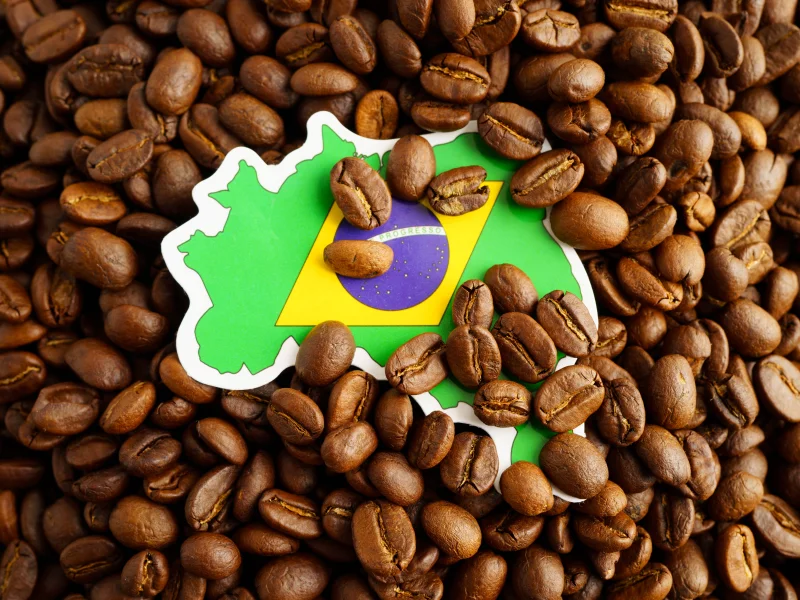
History of Coffee in Brazil
The history of coffee in Brazil is marked by economic, social, and cultural transformations. Coffee has become one of the country's main agricultural products and has helped build a significant part of the national identity. From its arrival in the 18th century to its current global prominence, coffee has gone through important cycles of expansion, modernization, and innovation.
Today, Brazil occupies a prominent position in the world market, being recognized as the largest producer and exporter of coffee, according to data from institutions such as the International Coffee Organization (ICO) and Embrapa Café.
The Arrival of Coffee in Brazil
The origin of the history of coffee in Brazil dates back to 1727, when the first seeds were introduced to the state of Pará. Historical records indicate that these seeds came from French Guiana, brought strategically to begin cultivation in Brazilian territory.
Initially, coffee did not have great economic relevance. However, Brazil's climatic conditions, especially temperature and soil, favored the development of the agricultural crop, allowing cultivation to gradually expand to other regions of the country.
Expansion Across Brazilian Territory
After its arrival, coffee spread rapidly to Rio de Janeiro and, later, to the Paraíba Valley, a region located between Rio de Janeiro and São Paulo. This movement marked one of the most important periods in the history of coffee in Brazil, as it consolidated the crop as a relevant economic activity.
During the 19th century, coffee became Brazil's main export product. This growth spurred investments in infrastructure, such as railways and ports, essential for the flow of production.
In addition, coffee production directly influenced territorial occupation and the emergence of new cities, especially in the interior of São Paulo.
The Coffee Cycle and its Economic Impact
The so-called coffee cycle was one of the most significant periods in the Brazilian economy. It not only generated wealth but also structured part of the country's urban and industrial development.
With the expansion of production to the interior of São Paulo, coffee farming gained scale and efficiency. Regions such as Ribeirão Preto, Campinas, and São Carlos became production and trade hubs.
This period also marked changes in the production model, with greater organization of farms and the beginning of more structured grain processing.
Social and structural transformations
The growth in production impacted the formation of cities, migratory flows, and the development of new economic activities.
Over time, the sector underwent important modernizations, especially in the 20th century. Agricultural mechanization and technological advancements began to transform how coffee was produced and processed.
These changes increased the country's efficiency and productive capacity, consolidating Brazil as a world leader in the sector.
Coffee in Brazil today
Currently, Brazil maintains its position as the world's largest producer and exporter of coffee, according to data from the International Coffee Organization (ICO) and reports from Embrapa.
The country stands out not only for its production volume but also for the diversity of coffee profiles, including traditional and specialty coffees, which value attributes such as aroma, acidity, sweetness, and body.
The coffee production chain is extensive and involves rural producers, cooperatives, roasters, industries, and exporters.
Technology and Industry Evolution
The evolution of coffee history is also linked to technological advancements in the industry. Today, process control, production standardization, and thermal efficiency are essential factors in ensuring quality.
Modern roasting demands precision, repeatability, and stability at all stages, which directly impacts the final result in the cup and the competitiveness of companies in the market.
SIATEC Brasil® Technology: Connection and Innovation
In a scenario that demands control and efficiency, industrial technology is the differentiator. At SIATEC Brasil®, we develop roasting solutions focused on performance and standardization. We manufacture equipment such as roasters, mills, silos, and ecological furnaces.
Our equipment guarantees quality on a large scale and productive predictability.
Let's work together to raise the standard of your coffee and conquer the world? Talk to us and discover how our technology can transform your production.