


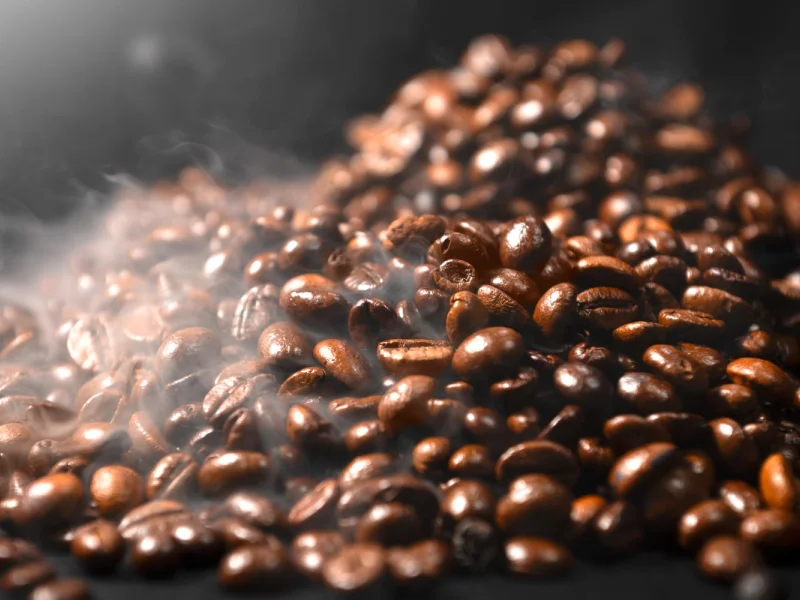
Post-Roast Cooling and Preservation of Coffee Aroma
Post-roast cooling is an essential step in preserving the sensory profile of coffee. After roasting is complete, the beans continue to release heat and maintain internal chemical reactions for a few seconds. Therefore, the cooling rate directly influences the retention of aromatic compounds and the stability of the final product.
When cooling occurs rapidly, thermal activity decreases within a few minutes. Thus, chemical reactions that could alter the sensory profile are interrupted. On the other hand, slow cooling allows residual heat to continue acting on the bean, which can cause overdevelopment and loss of important volatile compounds.
Industry research and scientific studies show that the ideal cooling window aims to reduce the coffee temperature to below 40 °C in up to four minutes. This interval reduces aromatic losses and helps preserve sensory characteristics defined during roasting.
Cooling Rate and Retention of Volatile Compounds
The cooling rate directly influences the stability of the aromatic compounds present in coffee. During roasting, chemical reactions generate hundreds of volatile molecules responsible for the beverage's characteristic aroma.
Among these compounds are aldehydes, pyrazines, furans, and aromatic alcohols. These molecules contribute to sensory notes such as chocolate, caramel, nuts, and balanced toasted aromas.
However, these compounds also exhibit high thermal sensitivity. When the beans remain hot for too long after roasting, some of these molecules can degrade rapidly.
Continuity of chemical reactions after roasting
Even after the coffee is discharged from the roasting drum, the bean still possesses high thermal energy. Thus, chemical reactions initiated during roasting continue to occur for a few seconds.
Among these reactions are processes associated with the Maillard reaction and the thermal degradation of sugars. These transformations produce important aromatic compounds during roasting, but can become excessive if cooling is slow.
When cooling occurs rapidly, these reactions slow down in a few seconds. Thus, the aromatic profile developed during roasting remains more stable.
On the other hand, prolonged cooling allows residual heat to continue acting inside the bean. In this scenario, chemical reactions advance beyond the ideal roasting point. As a consequence, overdevelopment occurs, which can reduce the sweetness and sensory complexity of the coffee.
Cooling time and impact on sensory profile
Experiments in the roasting industry show clear differences between cooling times. Tests indicate that coffees cooled in about four minutes better preserve the sweetness and balance of the beverage.
When post-roasting cooling exceeds five minutes, the heat still present inside the bean continues to act. In this scenario, some of the aromas may degrade. In some cases, the coffee develops a sensory character called "baked," used to describe beverages with a flatter flavor and lower aromatic intensity.
In addition, residual heat accelerates the degradation of sensitive aromatic compounds, such as 2-furfurylthiol, a molecule associated with the typical aroma of roasted coffee. Therefore, rapidly reducing the temperature of the beans helps preserve the volatile compounds responsible for the aromatic intensity of the beverage.
Thermal control and prevention of excessive roasting development
Controlling cooling after roasting is essential to maintain coffee standardization in the industry. When the temperature of the beans decreases rapidly, the thermal reactions initiated during roasting are interrupted with greater precision.
Thus, the sensory characteristics defined in the process remain more stable. In addition, rapid cooling prevents further transformations in sugars and aromatic compounds.
On the other hand, when cooling occurs slowly, residual heat continues to act inside the bean. This process can lead to excessive roasting development, reducing aromatic intensity and altering the sensory profile of the coffee.
Therefore, controlling the cooling rate is fundamental to maintaining sensory consistency between production batches.
Cooling Systems and Industrial Efficiency
In the coffee industry, the cooling of beans after roasting occurs through systems that combine forced ventilation and coffee movement. This process accelerates the removal of heat accumulated during roasting.
Adequate ventilation allows heat to dissipate quickly. In this way, the beans reach safe temperatures in a few minutes.
In addition, industrial equipment uses airflow sizing appropriate to the volume of coffee processed. In many systems, approximately 4 m³ of air per kilogram of coffee is considered to accelerate cooling.
This control helps preserve sensitive aromatic compounds and also contributes to greater stability during storage. As a result, the coffee maintains better aromatic intensity over time.
Equipment and Process Control
Controlling each stage of the process is fundamental to maintaining quality and consistency in roasting. Therefore, professional roasters depend on equipment capable of ensuring thermal stability, operational efficiency, and process standardization.
At SIATEC Brasil® we develop industrial equipment for coffee roasting, including roasters, grinders, silos, and more. The solutions are designed to meet the needs of roasters seeking greater process control, productivity, and operational reliability.
Contact us and request a no-obligation quote.