


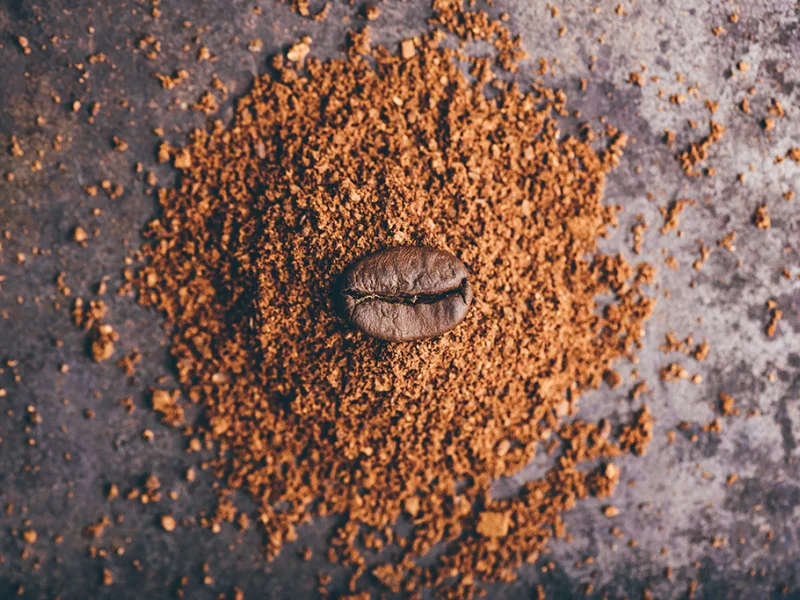
Coffee Particle Size in Extraction
The particle size of coffee directly influences the final result of the beverage. The size of the particles determines the speed at which water dissolves aromatic compounds during extraction. Therefore, understanding this variable helps control flavor, intensity, and sensory balance.
When the grind matches the brewing method, extraction occurs more stably. Thus, the beverage preserves sweetness, balanced acidity, and adequate body. On the other hand, incorrect adjustments can generate excessive bitterness or loss of sensory complexity.
In addition, roasters and industries use grind control to maintain consistency between batches. In this way, the product standard remains stable throughout production.
Grind size and extraction rate
The particle size alters the contact area between the water and the ground coffee. Smaller particles increase the surface area available for dissolving soluble compounds. As a result, extraction occurs more quickly.
On the other hand, larger particles reduce this contact area, and water passes through the coffee more easily. Thus, extraction tends to be gentler.
Water flow also depends on the grind. In pressurized systems, fine particles increase flow resistance, while coarser particles allow for freer water passage.
Therefore, the balance between grind and brewing method defines the efficiency of the extraction.
Influence of grind on bitterness and acidity
Particle size interferes with the sensory perception of the beverage. Finer grinds tend to intensify the body and structure, as more soluble compounds are extracted.
However, extremely fine particles can release excess bitter compounds, harming the balance of the beverage.
On the other hand, larger particles tend to generate lighter beverages, in which the acidity stands out more clearly.
Still, the final profile depends on other important factors, such as the degree of roasting, the origin of the coffee, and the brewing parameters.
Uniformity of grind and beverage stability
The consistency of the particles is essential to ensure stability in the extraction. When the grind has very different sizes, the process occurs unevenly.
In this context, smaller particles release compounds quickly, while larger ones take longer to extract aromatic substances.
As a result, the beverage may present a sensory imbalance.
Therefore, high-quality equipment seeks to reduce this variation, maintaining a more homogeneous particle distribution.
According to studies by the Specialty Coffee Association, the particle size distribution directly influences the efficiency of extraction and the quality of the beverage.
Particle distribution in different brewing methods
Each brewing method requires a specific grind size range, which ensures a balance between contact time and extraction.
Infusion methods use a coarser grind; the French press is a classic example. In this case, the prolonged contact time allows for gradual extraction.
Filtering methods use a medium grind, so that the water passes through the coffee in a controlled manner.
Espresso equipment requires a fine grind. As extraction occurs under pressure and in a few seconds, smaller particles favor the dissolution of aromatic compounds.
Therefore, adjusting the grind to the brewing method is essential to preserve the sensory profile of the beverage.
Sensory Profile According to Particle Size
The grind size directly influences the intensity and perception of acidity.
Very fine grinds tend to produce denser and more intense beverages, where caramel and chocolate notes stand out.
Medium grinds tend to produce greater sensory balance, with a better combination of sweetness, acidity, and body.
On the other hand, coarser particles favor lighter extractions, allowing delicate aromas to appear more clearly.
Thus, adjusting the grind makes it possible to direct the sensory profile of the final product.
Tools Used to Measure Particle Size
Particle size analysis can be performed with different instruments.
A common method uses calibrated sieves, which separate particles by size and allow for the evaluation of grind uniformity.
In addition, laboratories employ particle analyzers for more precise measurements of particle size distribution.
This monitoring helps roasters and industries maintain consistency during the production process.
Industrial Grinding Control
In the coffee industry, standardized grinding depends on equipment capable of maintaining operational stability.
SIATEC Brasil® Mills were developed to offer standardized and safe grinding. The system features an automatic stone separator, a feature that removes foreign bodies before the coffee goes to grinding.
In this way, the equipment remains protected and the process remains stable.
Contact SIATEC Brasil® and request a quote.