


Industrial Automation
Industrial Automation: When Industry Starts Thinking as a System
When processes cease to operate in isolation, operations gain predictability, control, and stability.
By integrating equipment, data, and commands into a single system, industry reduces failures, improves performance, and sustains quality standards continuously.
This model is not a trend. It is already a consolidated reality in industrial plants seeking proven efficiency.
What does it mean to operate the industry as a system?
Each piece of equipment begins to operate in a connected way, following predefined and monitored parameters.
Furthermore, decisions no longer depend exclusively on the individual experience of the operator.
Data begins to guide adjustments, corrections, and process control. Roasters, mills, silos, and reprocessing lines cease to be isolated elements and become part of a single intelligent system.
Integrated Industrial Automation and Process Standardization
Integrated industrial automation allows for the standardization of critical production variables.
Temperature, time, airflow, and speed no longer vary between shifts or operators. With this, the process remains stable even under different external conditions.
This control is widely used in the food, beverage, and thermal process industries, according to the ISO 9001 guidelines, which reinforce the importance of repeatability and process control.
Standardization ensures not only consistent quality but also economic predictability, since energy consumption and raw material utilization become measurable.
With intelligent systems, it becomes possible to record each batch produced, monitor quality indicators, and apply continuous improvements based on historical data. This strengthens quality control and consolidates the reliability of the entire operation.
Precise control reduces failures and rework
When systems operate in an integrated manner, human error is significantly reduced. Automation executes repetitive commands with constant precision. In addition, alarms and interlocks prevent critical deviations before they impact the process.
This set reduces rework, raw material losses, and unscheduled downtime. Automated systems minimize operational failures associated with manual variability, especially in continuous processes.
Another relevant point is safety. Automation protects operators and ensures that ideal operating conditions are met before the start of each stage. This predictability drives the company's operational maturity, making actions more strategic and less corrective.
The role of the operator in the age of automation
Industrial automation does not eliminate the role of the operator; it transforms their function.
Instead of performing manual tasks, the professional begins to act as an information manager. They analyze graphs, interpret results, and define operating strategies.
This evolution requires training, but offers more technical, safe, and productive working conditions. The operator becomes an active agent of quality. With data available in real time, they identify trends and anticipate possible deviations before they occur. This proactive vision is not possible without an automated system, since the simultaneous monitoring of multiple variables surpasses the capacity of human observation.
Understanding roasting as a system
Thinking of roasting as a system means understanding that each piece of equipment directly influences the performance of the others.
The grinding stage depends on the uniformity of the roasting, which, in turn, depends on thermal control. When these links are integrated, the process flows in a predictable and controlled manner.
This systemic thinking guides the most innovative industries. It transforms operations into intelligent production structures, in which each decision positively impacts the whole, generating continuous gains in performance and quality.
Industrial automation solution with SIATEC Brasil®
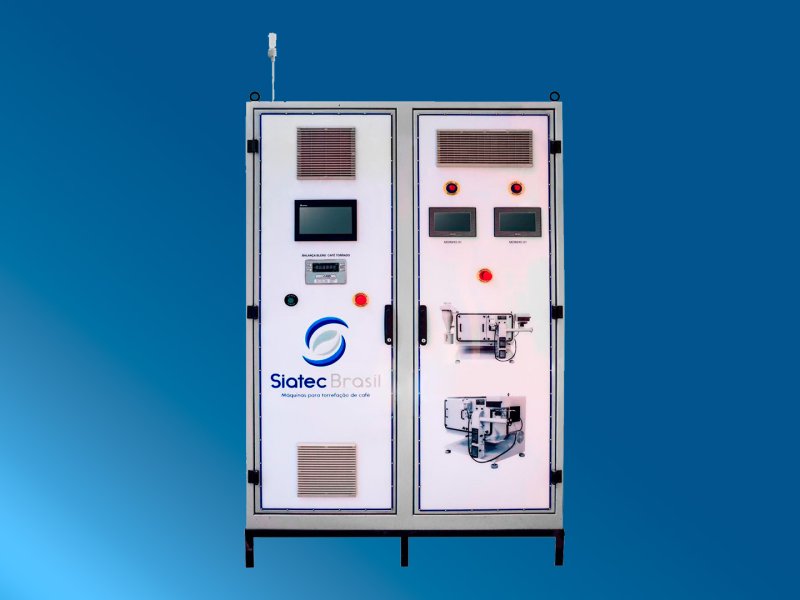
SIATEC Brasil®'s industrial automation was developed to integrate the entire operation in a technical and structured way.
Roasters, mills, silos, and reprocessing lines operate under a single intelligent system, with precise monitoring and automated control.
As a result, process repeatability is guaranteed, human errors are reduced, and operational performance is enhanced. The industry stops operating in parts and starts functioning as a complete, stable, and technically controlled system.
Contact SIATEC Brasil® and bring technology and precision to the center of your production.